The Uncreated Bridge investigates the relationship between the human gaze and digital visuality, focusing on the way in which perception is reshaped by technology. If in Between Times time was the working material, here the central theme becomes the gaze — the way in which the image is generated, perceived, and reinterpreted through digital media.
The title carries a double meaning: the bridge denotes the connection between the human gaze and the technologically generated one, while uncreated suggests the intermediate state of the image — a hybrid visual construct, situated between human control and the autonomy of the digital process. The bridge in the title is not an object, but a process. It is not a stone bridge, but a repeated gesture, a sustained intention, a continuous choice.
The project functions as a perceptual and reflexive experiment: an attempt to "see" the world through technology, while simultaneously examining the way in which it rewrites the logic of the gaze, of memory, and of visual representation.
The project follows the post-human theories of Joanna Zylinska, who argues that generative art is not a simple mechanical reproduction, but a form of coexistence between human thought and the automatic processes of visual generation.
Through the alternation between algorithmic generation and collage, the work reclaims a space of ambiguity: the resulting image is neither completely artificial nor completely human. This ambivalence reflects what Lev Manovich calls procedural aesthetics — a type of art in which process becomes more important than the finished result.
In perceptual terms, the work proposes an experience in which the viewer is no longer a passive spectator, but a participant in visual construction — what Claire Bishop defined as the participatory spectator: a figure who no longer contemplates the work, but contributes to its meaning. The role of the author thus shifts from operator to curator of variability.
The series was created through algorithmic generation and digital collage in Adobe Photoshop, combining AI-based visual synthesis tools — Generative Fill and Neural Filters — with manual interventions of selection, layering, and layer fusion. The process included three stages:
In this configuration, technology is no longer merely a medium, but an interlocutor — an instance that participates in the construction of visual meaning.
The Uncreated Bridge confirms the functioning of the Attention–Intention–Message model within a hybrid human–AI framework:
The central leitmotif of the series is the gesture of hands: the human hand — warm, imperfect, alive; the robotic hand — cold, precise, programmed. Between them remains a small yet infinite space — a suspended gesture, an unspoken question: Can we touch without losing ourselves?
The series comprises the works: The Ascent of Fragments, The Decisive Move, The Witness of Silence, and The Ecology of Time. Each proposes a distinct relationship with the theme of fragile coexistence between human perception and algorithmic logic: from the desire for contact and the responsibility of choice, to the cold observation of synthetic presence and affective temporality.

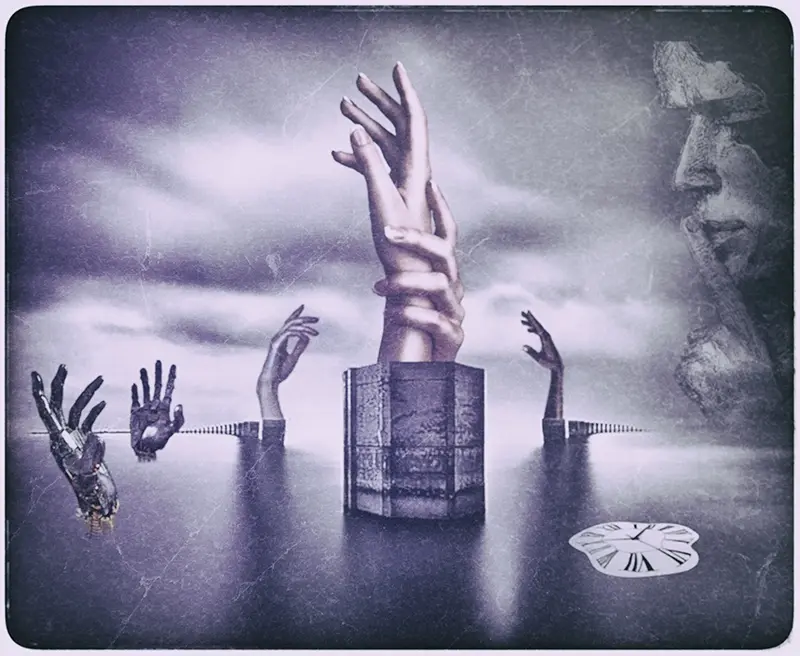


The Uncreated Bridge develops a post-anthropocentric aesthetics in which the image becomes a space of coexistence between human and technology — belonging to no single author, but resulting from a collaborative process in which human and digital perception complement each other.
The message is not total reconciliation, but the mapping of a fragile coexistence between sensory memory and programmed logic: authorship is distributed, and identity is negotiated in the zone of contact between skin and circuit.
Project documented and analysed in the volume From Real to Augmented. The Visual Artist in the Post-Photographic Era (2026), Chapter 19.